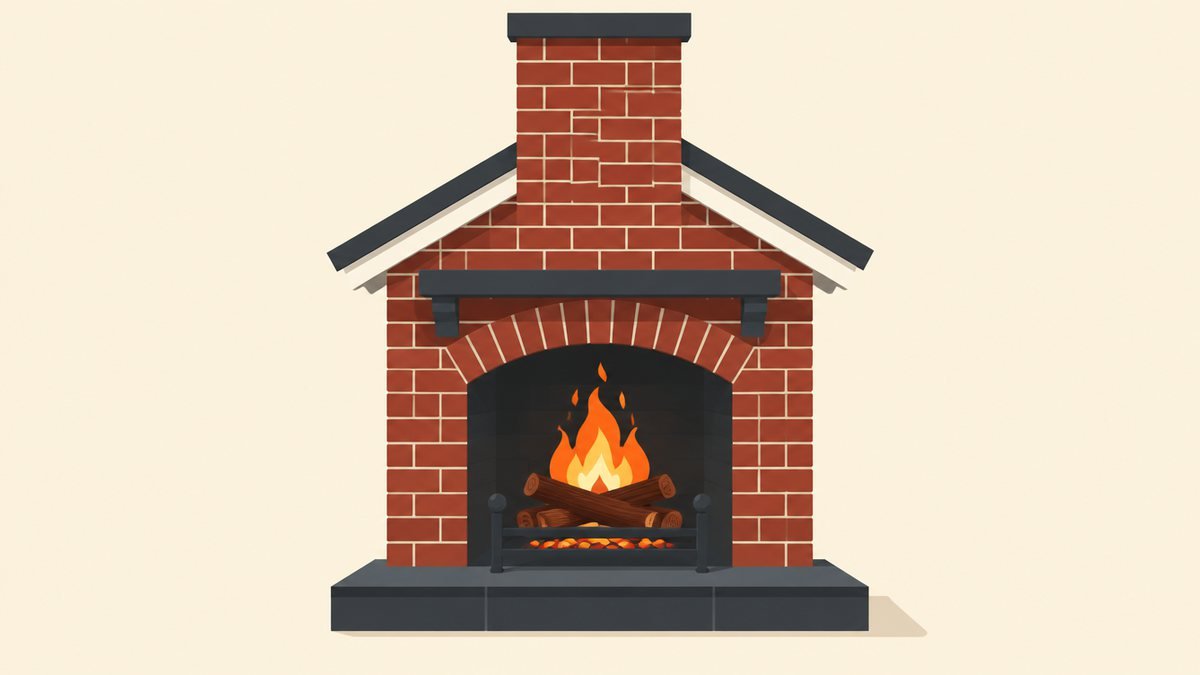
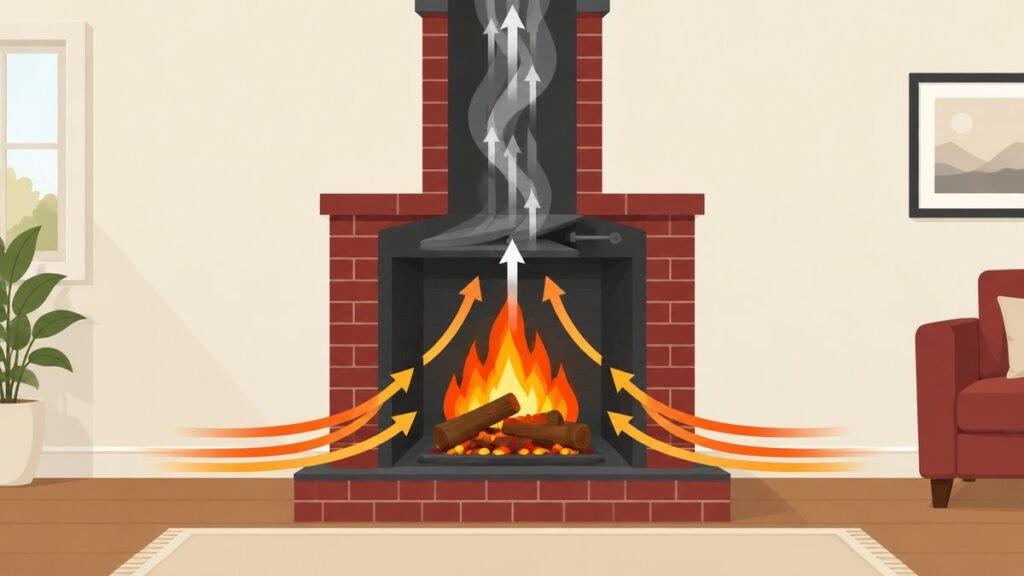
A fireplace works by drawing room air across the fire and letting the hot smoke rise up the chimney. The rising smoke creates a pull, called draft, that keeps fresh air flowing in as long as the flue is warm and open.
Whether that pull carries smoke up the flue or lets it spill into the room comes down to three things you can check: how warm the flue is, whether the damper is fully open, and whether the house itself is pulling air down the chimney. The rest of the fireplace, from the grate to the hearth, either feeds that airflow or protects your home from its heat.
Airflow in one picture
The numbers match the parts in the table below. Air enters at the front of the firebox, burns with the wood, and the hot gases leave through the throat, the smoke chamber and the flue.
The parts, from the fire to the sky
| No. | Part | What it does |
|---|---|---|
| 1 | Cap and crown | The cap keeps rain and animals out of the flue. The crown is the sloped slab that sheds water off the top of a masonry chimney. |
| 2 | Flue | The passage that carries smoke and gas out of the house. Most are lined so heat and acids do not reach the masonry. |
| 3 | Smoke chamber | The funnel-shaped space that narrows the opening above the fire down to the flue. |
| 4 | Damper and throat | The damper is a hinged metal plate in the throat, just above the firebox. It opens for a fire and seals the flue when the fireplace is idle. |
| 5 | Firebox | The brick or metal chamber where the fire burns. |
| 6 | Grate | A metal rack that holds the logs off the floor so air reaches them from underneath. |
| 7 | Hearth | The noncombustible floor in front of and under the fire that catches sparks and embers. |
Why the chimney pulls
Hot gases are less dense than the cooler air around them, so they rise. The Canadian Building Digest on domestic chimneys explains that this difference in density creates a draft, a slight negative pressure inside the flue compared with the surrounding air. The draft pulls fresh air into the firebox and pushes smoke out of the house.
Draft depends on temperature, so it is weakest when the flue is cold. At start-up the gas in the chimney is cool, the draft is low, and some smoke can spill into the room until the chimney warms up. Masonry chimneys store more heat than factory-built metal ones, so they take longer to start pulling well.
In mild weather a chimney stays cooler and the draft is lower. A chimney on an outside wall loses more heat than one inside the house, so its gases run cooler and it can be harder to get going.
What the damper really does
Think of the damper as a door in the chimney. It is a hinged metal plate that seals the fireplace when it is not in use. Open, it lets smoke leave. Closed, it keeps heated room air from escaping up the flue.
The working rules most owners need come from Harvard University Housing’s fireplace instructions for residents:
- Make sure the fireplace is cool, then find the damper handle just above the firebox and open it fully before you light anything.
- Hold a lit roll of newspaper near the opening. If the smoke goes up the chimney, the damper is open and the flue is drafting.
- Keep the damper open until the fire is completely out, and only then close it. A closed damper over live embers pushes smoke into the room.
Where the heat goes
A fireplace makes a lovely fire and a poor heater. EPA says a wood-burning fireplace is generally a very inefficient way to heat a home, because drafts can pull warm air up the chimney and leave other rooms cooler, and that fireplaces create about 20 times the air pollution of an EPA-certified wood heater.
If you want more heat from the same chimney, a certified insert or stove is a better answer than a bigger fire. The sections below cover what you can do with the fireplace you already have.
What affects how well it draws
- A cold flue. Warm it first by holding a lit roll of newspaper up near the damper before you light the main fire.
- A blocked or dirty flue. Creosote, nests and debris restrict the airflow. This is a reason for a yearly inspection, not a do-it-yourself fix. See chimney cleaning for what a sweep does.
- A house that is too tight. If doors and windows are sealed and exhaust fans are running, the house can pull air down the chimney instead of letting smoke rise.
- Wind and nearby structures. Turbulence around the top of the chimney can disturb the draft.
- Wet wood. It burns cooler and smokier. Our firewood guide explains how to tell dry wood from wet.
A simple routine
- Check that the damper is open and the flue is clear before you light a fire.
- Warm the flue with a roll of newspaper if the room is cold.
- Build the fire on a grate, with seasoned wood and a screen in place.
- Never leave the fire burning unattended.
- When the ashes are cool, close the damper.
For a step-by-step version, see our guide on how to start a fire in a fireplace.
Frequently asked questions
What is the part that opens and closes in a fireplace?
That is the damper, a hinged metal plate in the throat just above the firebox. Open it fully before you light a fire and leave it open until the ashes are cool.
Why does smoke come into the room when I light a fire?
The usual causes are a closed or partly closed damper, a cold flue that is not drafting yet, a blocked chimney, or a house under negative pressure. Warm the flue with burning newspaper first, and have a sweep check the chimney if it keeps happening.
Do fireplaces actually heat a house?
Not well. A wood-burning fireplace is generally a very inefficient way to heat a home, because warm room air can be pulled up the chimney. A certified insert or stove is a better heat source.
Does a gas or electric fireplace work the same way?
No. A gas fireplace burns gas through a burner and either vents the exhaust outdoors or, in ventless models, releases it into the room. An electric fireplace has no flame or chimney and makes heat with a heating element.
Sources
These are the pages behind the explanations above. The Burn Wise pages from EPA are no longer being updated, so check your local codes and your appliance manual for current rules.
- Energy Efficiency and Your Wood-Burning Appliance | US EPA
- CBD-217. Domestic Chimneys and Gas Vents | National Research Council Canada (archived copy)
- Proper Use of Your Fireplace (PDF) | Harvard University Housing
- Homeowner Resources | Chimney Safety Institute of America
- There’s a Chill in the Air: Stay Warm Safely | U.S. Consumer Product Safety Commission